
Manchester City and Manchester United share the same city, the same league, and one of football's fiercest rivalries. Yet in esports, their paths diverged completely.
City entered in 2016, partnered with FaZe Clan, built a 24.4M TikTok following, and fielded Fortnite rosters alongside FIFA. United waited until 2019, participated in league-mandated ePremier League tournaments, partnered with Konami's eFootball instead of EA Sports, and built minimal infrastructure. By 2026, one club turned esports into strategic market expansion. The other treated it as compliance.
This split reveals everything about sports clubs in esports. Between 2014-2026, 192 clubs entered competitive gaming. Some built empires. Most signed FIFA players and disappeared quietly.
Why Sports Teams Entered Esports
Four commercial drivers pushed traditional sports organisations into competitive gaming, each backed by measurable audience and revenue data.
1. Demographic arbitrage
Esports viewership skews 18-34, with 73% male audiences concentrated in high-value urban markets. Traditional sports broadcast audiences age upward annually whilst gaming viewership remains stable. Clubs entering esports weren't chasing trends—they were hedging against audience erosion in core demographics.
2. Geographic expansion without infrastructure
Broadcasting rights deliver regional audiences. Esports delivers global reach without physical presence:
- A Ligue 1 club can't penetrate Southeast Asian markets through match-day broadcasts alone
- Partner with a regional esports org, and you're visible in Jakarta, Manila, Bangkok
- Markets where football infrastructure doesn't exist but gaming communities do
3. Revenue model diversification
Match-day revenue died during COVID-19. Broadcasting deals stagnated. Esports offered alternative streams: digital sponsorships, merchandise unbounded by geography, content monetisation across streaming platforms. More critically, esports franchises proved to be tradable assets with measurable exit value—Schalke 04 sold an LEC slot for €26.5M.
4. Brand relevance insurance
When Real Madrid enters a market, it validates that market. When Bayern Munich participates in Virtual Bundesliga, esports becomes institutional rather than experimental. Late entrants weren't pioneers—they were validators signalling to sponsors, broadcasters, and boards that esports merited capital allocation.
Germany's Deutsche Fußball Liga understood this institutional shift. From the 2023-24 season, all Bundesliga and 2. Bundesliga clubs were required to participate in Virtual Bundesliga. Esports became a licensing requirement, not an optional marketing experiment.
How They Did It: The Impactful Clubs
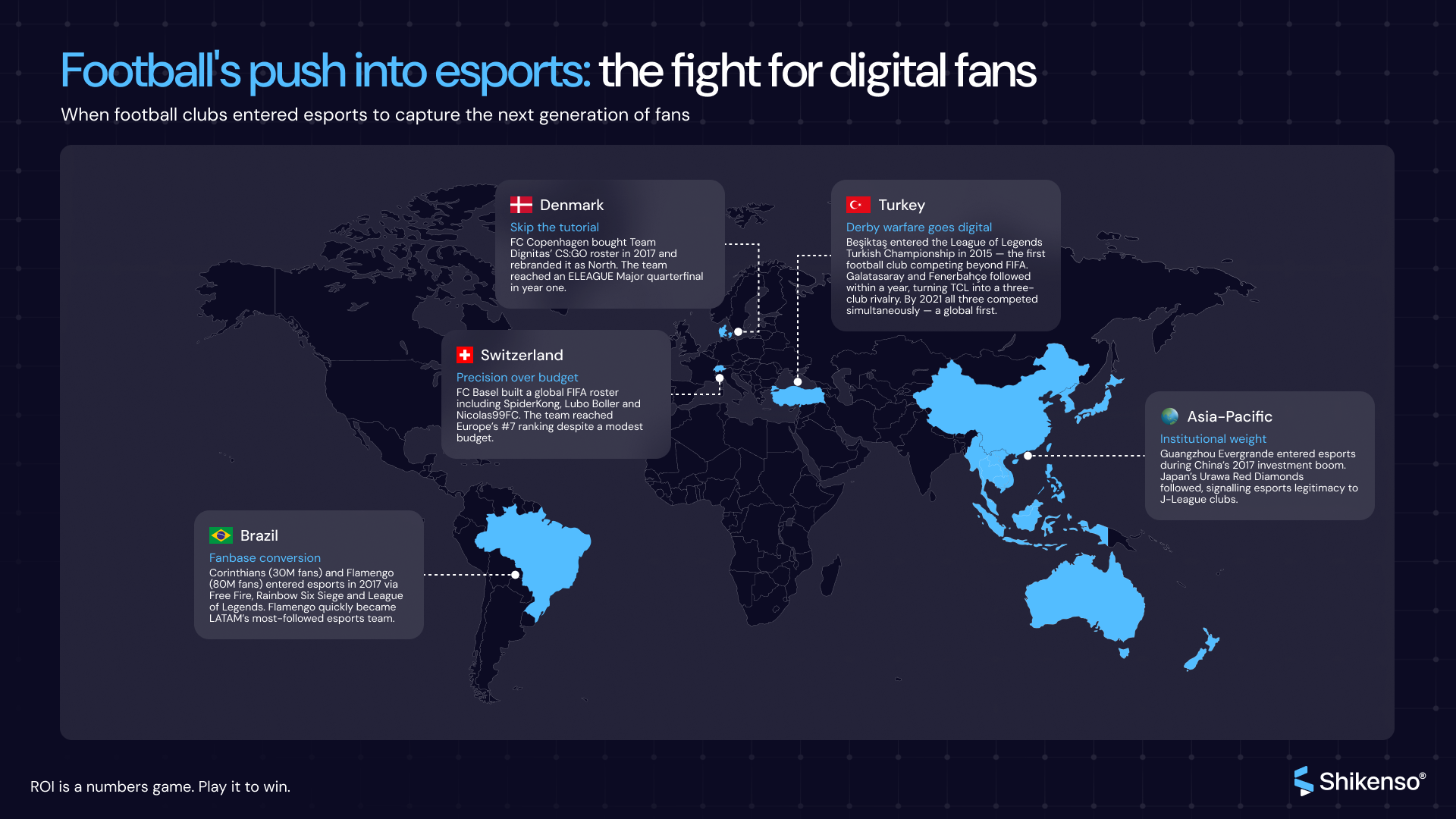
192 sports clubs entered esports between 2014-2023. Most exited quietly. These clubs built something measurable.
European Elite Leagues
Manchester City (England, 2016/2019) — The FaZe Alliance
What they built: Partnered with FaZe Clan rather than building infrastructure. FaZe brought 20M+ social followers and Gen Z credibility. City brought Premier League prestige and Emirati capital. Added Fortnite in 2021, signalling expansion beyond simulators.
The lesson: Don't compete with esports orgs—partner with them.
Wolverhampton Wanderers (England, 2016/2021) — The Reverse Conquest
What they built: Mid-tier Premier League club leveraged Chinese ownership (Fosun International) to build an Asian empire. Acquired Chongqing QGhappy (six-time Honor of Kings champions) in September 2021.
By 2025:
- Seven Chinese esports divisions
- ¥200M ($28M) state investment for 10,000 sqm arena in Chongqing (2,000 seats, opening late 2025)
- 130+ offline events hosting 200,000 spectators
- Physical café and retail store in Chongqing
- VALORANT team reached Top 4 at VCT Masters Toronto 2024
The lesson: Regional domination beats global aspiration.
FC Eintracht Frankfurt (Germany, 2018) — The Infrastructure Blueprint
What they built: While many Bundesliga clubs approached esports only after the Virtual Bundesliga mandate, Eintracht Frankfurt had already spent five years building infrastructure. By 2023, the club operated a dedicated academy, two professional divisions, and secured a title sponsorship from one of Europe’s largest financial institutions.
Timeline
- 2018 — Entered esports via EintrachtTech with a virtual football programme, built around mass participation and community engagement.
- 2020 — Expanded into League of Legends, introducing a formal esports membership structure across EA FC and LoL — among the first Bundesliga clubs to do so.
- 2023 — Opened the Deutsche Bank Esports Academy at EintrachtLab, co-located with the club’s professional football training ground. The purpose-built facility includes dedicated coaching staff, performance infrastructure, and regular community programming. Later named German Digital Champion 2025, the highest digital ranking among Bundesliga clubs.
- January 2024 — Entered VALORANT as the first Bundesliga club to compete in VALORANT Challengers DACH, adding a second tier-two professional division alongside League of Legends.
Why it worked: Frankfurt committed early and at depth. By 2024, the club had a named facility, a major financial institution as title partner, multi-genre professional teams, and a structured “Talents of Tomorrow” pathway for regional player development.
The lesson: Early, voluntary investment compounds. Clubs that built infrastructure and attracted institutional partners sustained competitiveness over time. Mandated entrants continue to close that gap.
FC Schalke 04 (Germany, 2016-2021) — The €18.5M Exit
The numbers: Bought an LEC franchise slot for €8M (May 2016). Competed five years, finishing 3rd in 2019 Summer and 4th in 2021 Spring. COVID-19, Bundesliga relegation, and €217M debt forced liquidation. Sold to Team BDS for €26.5M in June 2021.
Return on investment: 231% in two years.
The lesson: Esports franchises are balance-sheet assets with exit markets.
RB Leipzig (Germany, 2017) — The Talent Machine
What they built: Applied Red Bull's talent development model to FIFA esports. RBLZ Gaming won VBL Club Championship three times (2022, 2023, 2025—current record holders).
Key signings:
- FIFA World Champion Umut 'RBLZ_Umut' Gültekin
- Anders 'Vejrgang' Vejrgang: 536 consecutive Weekend League wins (FIFA 21)
When Virtual Bundesliga became mandatory in 2023, Leipzig had six years of infrastructure advantage over clubs starting from zero.
The lesson: Talent pipelines matter more than budgets.
FC Barcelona (Spain, 2018) — Methodical Expansion
Timeline: eFootball (2018) → Rocket League (2019) → Hearthstone (2020) → League of Legends (2021)
By 2025: competing in Spain's SuperLiga with dedicated Camp Nou facilities, full coaching staff, and academy infrastructure.
The lesson: Patience compounds—still competing whilst others exited.
Real Madrid (Spain, 2020) — The Validator
What made it matter: Entered during COVID-19 when most clubs were cutting costs. Fourteen-time European champions, €831M revenue, world's most valuable football brand validated esports as institutional infrastructure during a pandemic.
The lesson: Late entry can signal validation more powerfully than pioneering.
Paris Saint-Germain (France, 2016) — The Global Empire
What they built: PSG entered esports in October 2016 with FIFA — and never stopped expanding. Over the following decade, the club built one of the most geographically diverse esport portfolios of any traditional sports organisation, fielding teams across Asia, Southeast Asia, the Middle East, and Europe, with a dedicated studio facility anchoring it all.
Infrastructure
- PSG Studio (Boulogne-Billancourt, HQ): A 140m² esports facility opened in 2021, housing professional teams' training operations and the Paris Saint-Germain Academy Esports programme — offering structured development pathways for amateur players across multiple titles.
Division-by-Division Breakdown
- Dota 2 — PSG.LGD (2018–2023): Partnered with Chinese powerhouse LGD Gaming to create PSG.LGD. Reached The International finals twice (2018, 2021), accumulating $18M in prize money across the partnership. Five years of co-branded competition before the partnership concluded in September 2023.
- League of Legends — PSG Talon (2020–2025): Partnered with Hong Kong-based Talon Esports to compete in the Pacific Championship Series (PCS). The co-branded team became the most successful in PCS history — winning 8 of the league's championships and qualifying for the League of Legends World Championship five times (2020, 2021, 2023, 2024, 2025). The partnership was paused in January 2025 amid shifting strategic priorities, renewed in July 2025 with Qatar Airways joining as front-of-jersey sponsor, then concluded again in November 2025 when Talon was removed from the LCP by Riot Games following financial irregularities.
- Rainbow Six Siege — PSG Talon (2024–present): Launched a South Korean R6 Siege team in partnership with Talon Esports in March 2024. The team won Stage 1 of the 2024 South Korea League in its debut season and became the sole South Korean representative at the inaugural 2024 Esports World Cup.
- Arena of Valor — PSG (2021–2025): Competed in Thailand's RoV Pro League with an all-Thai roster. The division was wound down in December 2025.
- Rocket League — PSG (2017–2019): Won the ESL Championnat National (2017) and DreamHack Leipzig (2018) before the division was dissolved.
- EA FC / FIFA — PSG (2016–present): The original and longest-running esports division. PSG entered through FIFA in 2016 and has continued to evolve the programme. From the 2025–26 season, PSG Esports entered a long-term collaboration with French esports organisation Team Vitality — forming PSG.Vitality. The joint roster competes under the PSG banner with training conducted at the PSG Studio, targeting the eLigue 1 title in 2026 and a Top 8 finish in major international competitions.
- Mobile Legends: Bang Bang — PSG.RRQ (2019): A seven-month partnership with Indonesian powerhouse Rex Regum Qeon — making PSG the first traditional sports club to enter mobile esports. The partnership ended in July 2019 as the club refocused its portfolio.
By 2025: seven active or historical divisions spanning Europe, Asia, and Southeast Asia.
The lesson: Global infrastructure requires regional partnerships. PSG's empire was built through carefully selected local operators with existing audience bases in each market.
Other Notable European Clubs:
2023-2026: The Infrastructure Era
Market consolidation replaced expansion. Clubs entering in 2023-2026 focused on infrastructure depth rather than portfolio breadth.
Four Consolidation Trends (2023-2026)
Germany's regulatory mandate
Virtual Bundesliga participation became licensing requirement for all Bundesliga and 2. Bundesliga clubs from 2023-24 season. Thirty-five clubs compete by 2024, including Bayern Munich and Borussia Dortmund—both late entrants forced by regulation rather than strategy.
Infrastructure investments replaced player signings
Eintracht Frankfurt opened Deutsche Bank Esports Academy at EintrachtLab in 2023 with dedicated facilities, coaching staff, and performance infrastructure. Named German Digital Champion 2025 for esports integration. Entered VALORANT in January 2024, becoming first Bundesliga club in tactical shooters. Wolves' £20M arena represents largest football club esports infrastructure investment globally.
Genre expansion beyond simulators
Football clubs historically defaulted to FIFA/EA Sports FC. 2024-2025 saw movement into VALORANT (Eintracht Frankfurt), sustained League of Legends divisions (Barcelona, PSG Talon), and maintained CS:GO operations. Clubs treating esports as sport rather than marketing expanded beyond familiar IP.
Market consolidation metrics
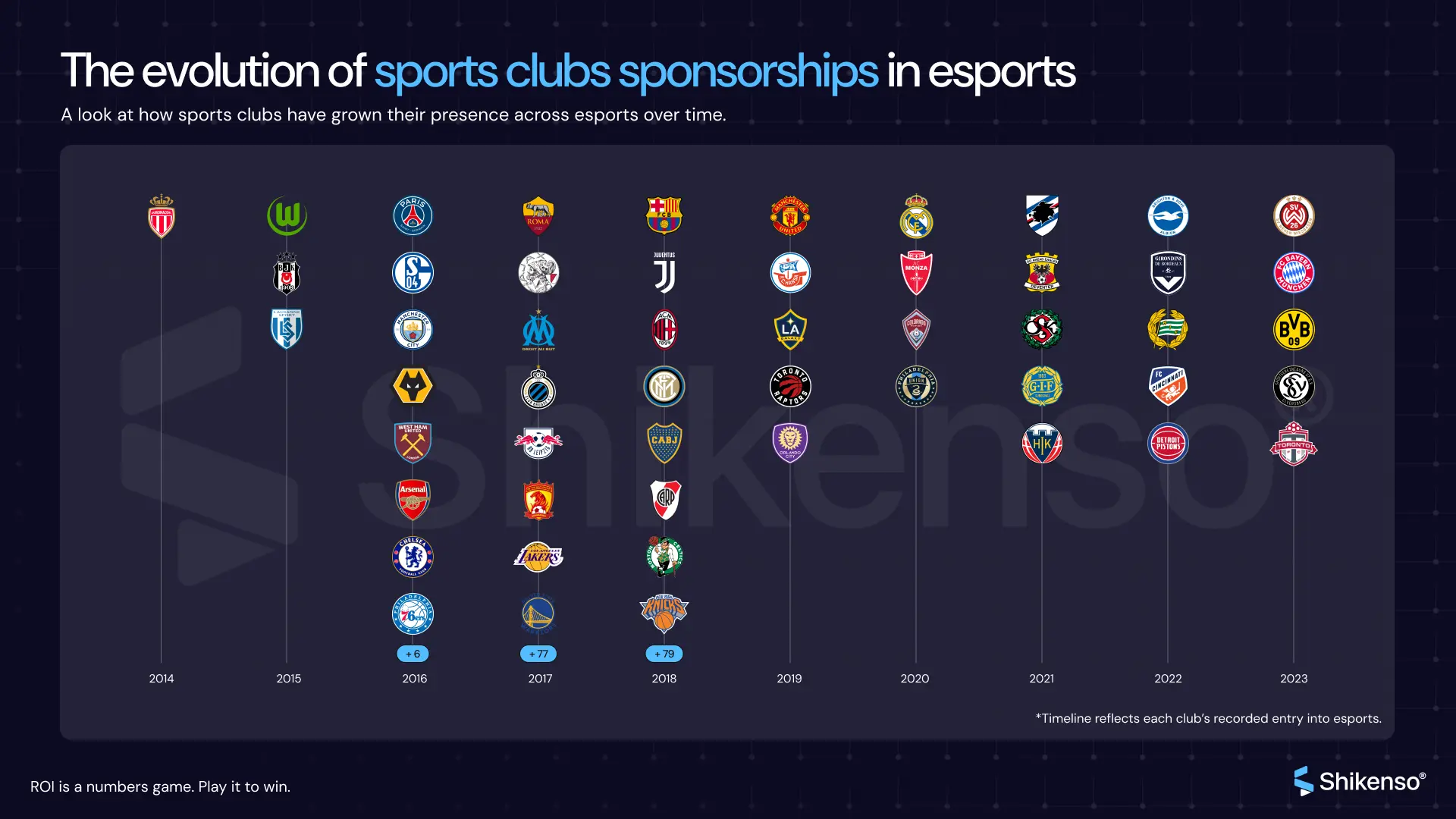
Peak entry year 2018 saw 72 new clubs. By 2023, zero voluntary new entries outside regulatory mandates. Active clubs with competitive divisions beyond FIFA: approximately 25 globally. Market evolved from quantity to sustainability.
Full Dataset: 192 Sports Clubs (2014-2023)
Below is the comprehensive reference table with all verifiable entries:
The Bottom Line
Measurement standards tighten as sponsors demand attribution beyond social reach. The clubs still competing in 2026—Wolves' regional empire, RB Leipzig's talent pipeline, Eintracht Frankfurt's multi-genre expansion—prove infrastructure depth signals commitment better than portfolio count. For brands evaluating sports club esports partnerships: look for operational excellence, not jersey inventory.

Related reads


Get new insights straight to your inbox
Don’t miss out on the insights that the press and media rave about!